Accepting Payments in SAP Without Expanding Your PCI Footprint
Integrating payment acceptance into SAP can create significant efficiencies for Finance and A/R teams.
The Question
But it also raises an important question:
What happens to your PCI DSS scope when credit card payments become part of your SAP workflow?
Payment integration should simplify operations, not create unnecessary security and compliance responsibilities.
That's one of the key advantages of processing payments through the SAP Digital Payments Add-On (DPA). By combining SAP's payment architecture with a certified payment service provider's processing capabilities, organizations can securely accept payments while limiting the exposure of sensitive cardholder data within their SAP environment.
The Risk
Why PCI Scope Matters
The more systems, applications, and employees that interact with cardholder data, the more complicated securing that environment can become.
Consider a traditional payment workflow. A customer provides card information to an employee, who enters it into a payment application. The transaction is processed separately and then reconciled back to SAP.
Every additional touchpoint can introduce risk and potentially increase PCI compliance responsibilities.
A better approach is to minimize where sensitive payment information exists in the first place.
Tokenization
Keeping Sensitive Card Data Out of SAP
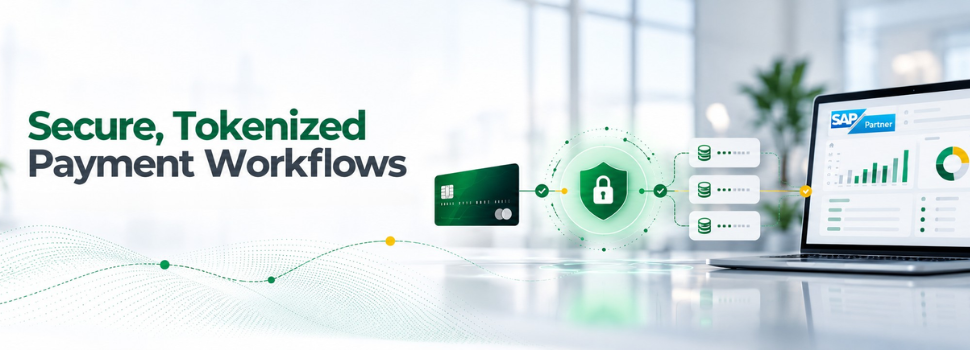
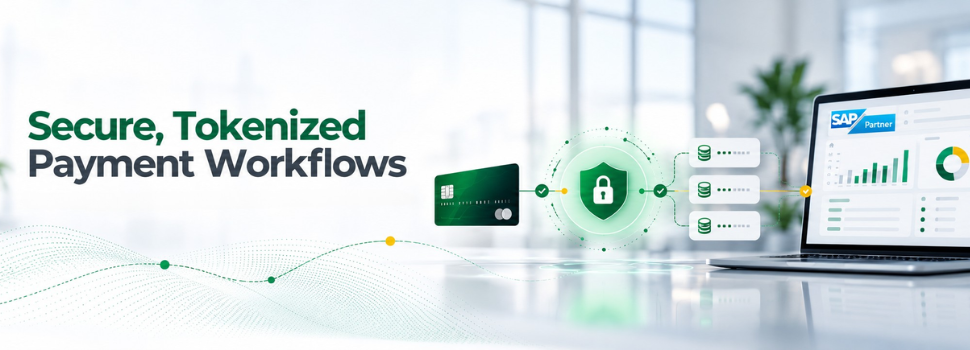
One of the fundamental security components of the SAP Digital Payments Add-On is tokenization.
Instead of storing the actual card number within SAP, sensitive payment information is handled within the secure payment-processing environment and replaced with a token. That token can then be used throughout the payment workflow without exposing the underlying card number within SAP.
For Finance teams, payments remain connected to the SAP workflow. From a security perspective, however, sensitive cardholder data is kept away from the ERP environment.
The concept is simple
If your systems don't need sensitive payment data, don't put it there.
This approach can help organizations:
- Reduce exposure to sensitive cardholder data
- Reduce the systems included within the PCI DSS environment
- Limit unnecessary employee interaction with payment information
- Reduce the risks associated with storing card data internally
- Simplify ongoing security and compliance efforts
The Human Factor
Reducing Human Exposure Matters Too
PCI scope isn't only about technology. Organizations should also consider how employees receive payment information.
- Are customers reading card numbers to A/R representatives over the phone?
- Is payment information being written down or sent through email?
- Are employees moving between SAP and another application to process transactions?
Each additional step creates another potential point of exposure.
Integrated and tokenized payment workflows can reduce the number of employees and systems that need to interact with sensitive payment information. That's good security practice regardless of PCI requirements.
Efficiency
Security Without Sacrificing Efficiency
Improving security shouldn't make payment processing more difficult.
Through the SAP Digital Payments Add-On, payment processing remains connected to the SAP workflow while the underlying payment credentials are handled securely outside the ERP.
Finance teams can continue working within SAP while supporting:
For recurring customers, tokenization also means payment credentials can be securely referenced for future transactions without repeatedly collecting or exposing the underlying card information.
The result is a more secure payment architecture without adding unnecessary friction to the Finance workflow.
Evaluation Checklist
Look Beyond the Transaction
When evaluating an SAP payment integration, organizations should look beyond whether the transaction can simply be processed. Ask:
- Where does the sensitive payment information go?
- Who can access it?
- Where is it stored?
- How much of our environment becomes part of our PCI compliance responsibilities?
Those questions should be addressed as part of the integration strategy, not after implementation.
The objective for Finance and IT
Integrate payments into SAP without unnecessarily expanding your payment-data footprint.
How UTA Helps
Secure Payment Acceptance Connected to SAP
United TranzActions (UTA) helps organizations evaluate how payment acceptance fits into their existing Finance and A/R workflows, including environments using SAP.
By supporting secure, tokenized payment processing, UTA can help businesses reduce unnecessary exposure to sensitive cardholder data while keeping payment activity connected to the systems their teams already use.
Is Your SAP Payment Workflow Limiting Your PCI Exposure?
If you would like to explore how payment acceptance within SAP can be structured to reduce unnecessary exposure to sensitive cardholder data, we'd welcome the opportunity to review your current payment workflow and identify areas where you may be able to strengthen security, reduce PCI scope, and simplify the overall payment process.
Vice President, Business Development
mtapia@unitedtranzactions.com | 800.858.5256 ext. 3028 | Direct: 786.264.7028
www.unitedtranzactions.com
Certainty is our Guarantee!